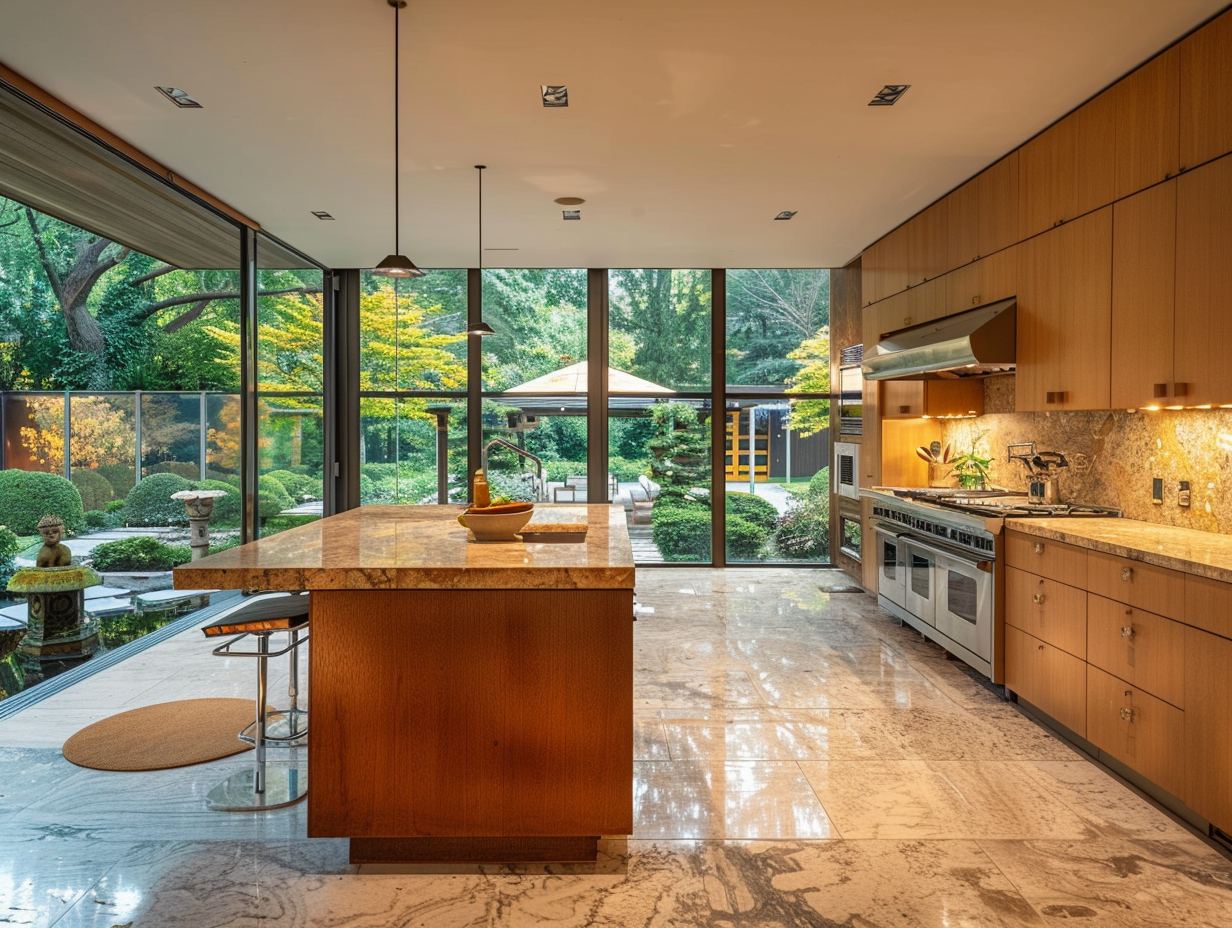
A few months ago, a friend invited me over to see the 1958 ranch house she just bought. It still had the original kitchen. Long, low walnut cabinets. A cooktop set right into the counter. A wall oven at eye level. A little pass-through window into the dining room.
Nothing in that kitchen was trying hard. It just worked.
That same week, I scrolled past a listing for a “mid century modern” remodel. It had orange bar stools, a Sputnik light, and a starburst clock. The cabinets? White Shaker doors with crown molding. The whole thing felt like a costume.
That’s the gap I want to talk about. Mid century modern kitchens are hugely popular right now, but a lot of what gets labeled “MCM” is really just a few retro props stuck in a modern kitchen. The real look comes from the details. Here’s how to tell the difference, and how to get it right.
A Quick Look Back
The mid century modern era ran roughly from the mid-1940s to the late 1960s. After World War II, families moved to the suburbs, and builders were putting up ranch homes fast.
Designers at the time cared about a few big ideas:
- Simple shapes. No extra fuss, no carved details.
- Function first. Every piece had a job.
- Natural materials. Lots of warm wood, often walnut, teak, or birch.
- Connection to the outdoors. Big windows and open sight lines.
- New technology. Built-in appliances were exciting and new.
Keep those ideas in mind. They’re the test for every choice you make. If a detail doesn’t match them, it probably isn’t authentic.
1. Flat Slab Cabinet Doors
This is the number one giveaway. Real mid century modern kitchens almost always have flat slab doors. No raised panels. No frames. No grooves. Just a clean, flat surface.
Shaker doors, the ones with a simple frame around a center panel, are lovely. But they belong to a different style. Put Shaker doors in a “mid century” kitchen, and it instantly turns into a modern farmhouse with retro decor.
Slab doors in a rich wood veneer are the classic choice. Walnut is the most iconic. Teak and birch were common too. Painted slab doors in soft colors also show up in a lot of original homes.
Look for: Wood grain that runs horizontally across the doors. This makes the cabinets feel long and low, which was a big part of the look.
2. Long, Low, Horizontal Lines
Mid century homes are wide and grounded. Low rooflines, long windows, and stretched-out furniture.
The kitchens follow the same rule. Cabinets often run in long, unbroken rows. Upper cabinets might be shorter, or skipped on one wall entirely in favor of a window or open shelf.
Many imitation kitchens run tall cabinets all the way to the ceiling with thick crown molding on top. That’s a custom-traditional look. It pulls your eye up, which is the opposite of what MCM design wants.
If you do want uppers, keep the tops simple and flat. Skip the crown molding completely.
3. Hardware That Almost Disappears
Mid century designers didn’t want hardware to steal the show. You’ll often see:
- Integrated pulls, where a groove or lip is cut right into the door or drawer edge
- Small, simple pulls in brushed metal or wood
- Slim tab pulls on the top edge of drawers
- Round knobs that are small and plain
What you won’t see much of are big, chunky bar pulls or ornate cup pulls. Those come from other styles.
Here’s a quick test. Step back from the cabinets. If the hardware is the first thing you notice, it’s probably too loud for a true MCM kitchen.
4. The Right Countertops
Countertops are where a lot of remodels go off track.
In the original era, the most common countertop was laminate. Brands made patterns like boomerang shapes, tiny flecks, and solid colors. Many had a metal edge trim, often aluminum or stainless steel.
Other authentic choices include:
- Terrazzo, which has chips of stone or glass in a smooth surface
- Butcher block, especially on islands or peninsulas
- Stainless steel in more industrial-style homes
White marble with heavy gray veining is beautiful. But it leans traditional or European. Busy granite was a 1990s and 2000s thing, not a 1950s thing.
If laminate feels too dated to you, a solid-color quartz with very little pattern is a good modern stand-in. Keep it simple.
5. Color Done the Right Way
Many people think mid century modern kitchens are all about orange and teal. That’s mostly a myth, or at least an exaggeration.
Original kitchens usually had a warm wood base, then one or two pops of color. And the colors were varied. You’d see:
- Soft pastels like mint green, pale yellow, and pink
- Earthy tones like mustard, olive, and rust
- Bold accents like turquoise or tomato red
Appliances themselves often came in colors. Pastel ovens and fridges were a big deal in the ’50s.
The key is restraint. One colorful backsplash, or a set of painted lower cabinets, or a colorful range. Not all three at once. When everything is bright, it starts to feel like a theme restaurant.
6. Backsplash and Tile Choices
Original backsplashes were usually simple. Popular choices included:
- Small square tiles, often 4×4 inches, in solid colors
- Mosaic tile in little squares or simple patterns
- The same laminate as the counters, run up the wall
- Wood paneling in some homes
Subway tile and long, skinny tiles are more of a modern look. They’re not wrong exactly, but they don’t scream mid century.
Geometric patterns can work well. Just keep them clean and simple. Think repeating circles or soft angles, not busy Moroccan prints.
7. Lighting That Fits the Era
Lighting is a fun place to add personality. It’s also where a lot of fake MCM kitchens overdo it.
The famous Sputnik chandelier, with all its arms sticking out, is iconic. But it’s more of a dining room or living room fixture. In a kitchen, it can feel like a prop.
Better kitchen choices include:
- Simple globe pendants in white glass
- Cone-shaped pendants in metal
- Bubble lamps made from a soft, round shade
- Flush mount lights with clean, round shapes
Original kitchens often had a fluorescent ceiling box too. You don’t need to copy that part. Warm LED lights give you the look without the flicker.
8. Floors That Feel Authentic
Flooring is easy to forget, but it makes a big difference.
Original mid century kitchens had floors like:
- Linoleum in solid colors or patterns
- Vinyl tile in a checker or speckled pattern
- Cork, which is warm and soft under your feet
- Terrazzo in higher-end homes
Gray “wood look” plank floors are a dead giveaway of a 2015 remodel. If you want wood, go with a warm, medium tone. Or try cork. It’s comfortable, eco-friendly, and very true to the period.
9. Built-In Appliances and Smart Layouts
Mid century designers loved new technology. Built-in appliances were a big deal.
Look for features like:
- Wall ovens set into a tall cabinet
- Cooktops dropped right into the counter, instead of a full range
- Pass-through windows into the dining room
- Peninsulas that open the kitchen to the living space
Layout matters too. Many original kitchens were open to the dining area, with a low counter or peninsula between them. The idea was that the cook could talk with family while making dinner. That was pretty new for the time.
If you’re remodeling, think about how the space flows, not just how it looks.
Signs of an Imitation MCM Kitchen
Here’s a quick checklist. If a kitchen has several of these, it’s probably a modern kitchen in a retro costume:
- Shaker or raised-panel cabinet doors
- Thick crown molding on the uppers
- A farmhouse apron-front sink
- Gray wood-look floors
- Big, chunky modern hardware
- Heavy veined marble or busy granite
- Retro decor items (clocks, signs, bar stools) doing all the heavy lifting
Decor is the easiest thing to change. If the “mid century” vibe disappears the moment you remove the starburst clock, the bones aren’t really MCM.
Keeping It Livable
Here’s my honest advice. You don’t have to build a museum.
Some original features just aren’t practical today. Old laminate scratches easily. Original wiring can be unsafe. Tiny fridges don’t fit modern grocery runs.
The best mid century modern kitchens I’ve seen respect the era without copying it exactly. They keep the slab doors, the warm wood, the long lines, and the simple hardware. Then they add modern comforts like quiet dishwashers, induction cooktops, and good under-cabinet lighting.
That’s not cheating. That’s exactly what the original designers would have done. They loved new technology. They’d want you to use the best stuff available.
The Bottom Line
Mid century modern kitchens aren’t about retro props. They’re about simple shapes, warm materials, honest function, and a calm, low, horizontal feel.
Start with the bones. Slab doors, the right wood, quiet hardware, simple counters, and a smart layout. Then add color and decor with a light touch.
My friend’s 1958 kitchen didn’t need a single starburst clock to feel mid century. It just was. That’s the goal. A kitchen that feels like it belongs to the era, not one that’s dressed up for it.